Gramática · G1
Present Simple vs Present Continuous
your daily reruns vs your live stream
el presente simple y el presente continuo
In this unit
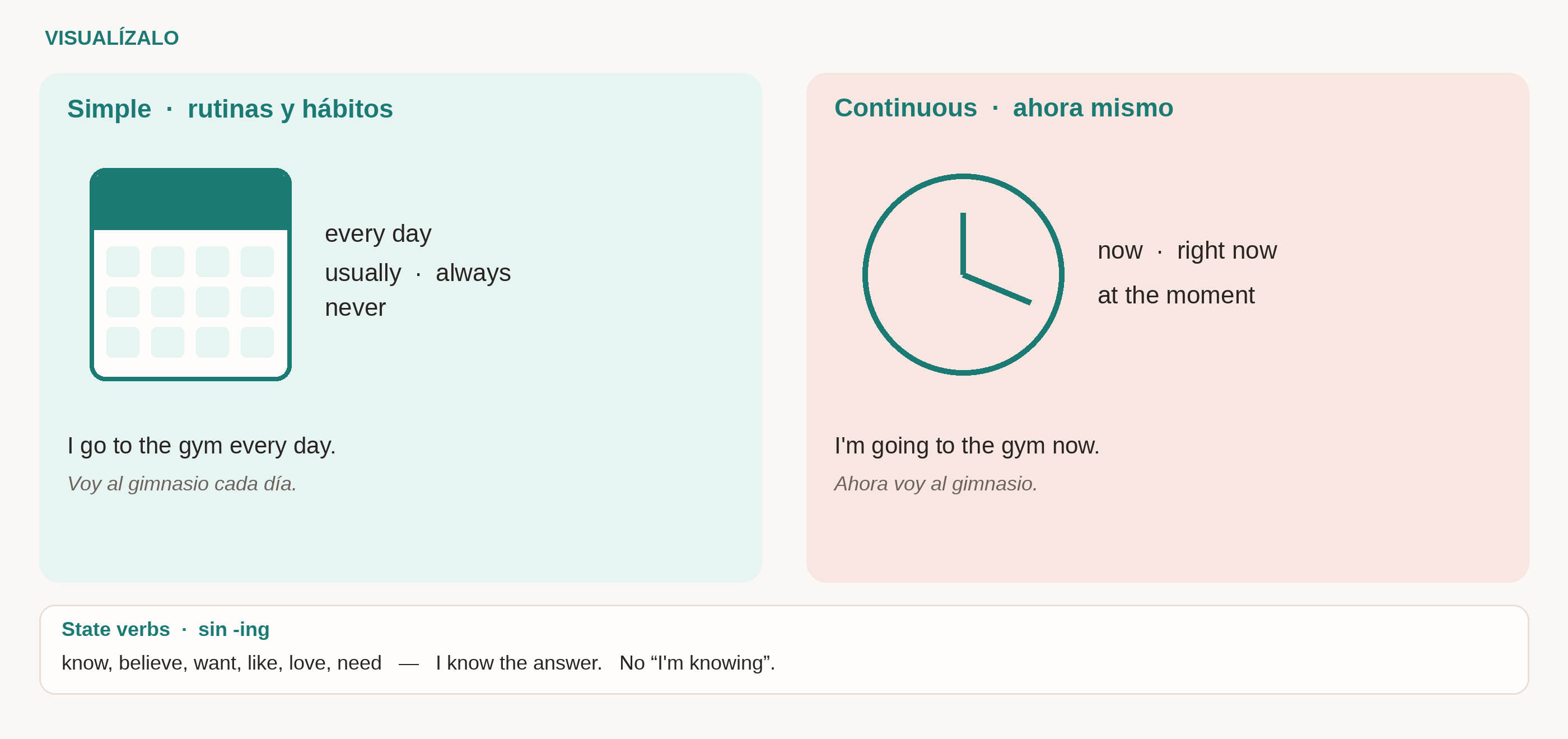
English has two present tenses, and they do different jobs. You use the present simple for things that are always true or that happen again and again — habits, routines and facts. You use the present continuous (am/is/are + verb-ing) for what is happening right now, or around now, and for situations that are only temporary. In this unit you'll learn how to choose the right one, and why a few 'state' verbs like know, want and love almost never take -ing.
El inglés tiene dos presentes con usos distintos. El presente simple sirve para lo que siempre es verdad o se repite: hábitos, rutinas y hechos. El presente continuo (am/is/are + verbo-ing) sirve para lo que pasa ahora o en este momento, y para situaciones temporales. Aquí aprenderás a elegir el correcto y por qué verbos de estado como know, want o love casi nunca llevan -ing.
How you'll practise: Present simple or present continuous? · True or False? · Circle the mistake, then write the correct version below · Make the sentence negative · Your real life.
El slang se queda en la frase. Toca la palabra con puntos — o clic derecho — y sale qué significa.
The story of English · la historia
Most languages have one present tense; English has two, and the second one has a clear reason to exist. The '-ing' form began as a noun in Old English (before 1100): 'he is on hunting' meant 'he is busy at the hunt' — in the middle of doing it. Because that phrase already meant 'in the middle of an action', it naturally took the job of 'happening now', while the plain verb kept habits and facts. Later 'on hunting' shortened to 'hunting' ('he is hunting'), and the form became common in the 1700s–1800s. Spanish works the same way with 'estar + -ando' ('estoy estudiando'), so this one is easy.
La mayoría de los idiomas tienen un presente; el inglés tiene dos, y el segundo existe por una razón clara. La forma '-ing' empezó como sustantivo en inglés antiguo (antes de 1100): 'he is on hunting' significaba 'está ocupado cazando' — en plena acción. Como esa frase ya significaba 'en mitad de una acción', asumió de forma natural el trabajo de 'pasando ahora', mientras el verbo normal se quedó con hábitos y hechos. Luego 'on hunting' se acortó a 'hunting' ('he is hunting'), y la forma se hizo común en los siglos XVIII–XIX. El español funciona igual con 'estar + -ando' ('estoy estudiando'), así que este es fácil.
In plain English · en cristiano
Use the present simple for habits and facts, and the present continuous (am/is/are + -ing) for what's happening now. A few state verbs like know, want, love almost never take -ing.
Usa el presente simple para hábitos y hechos, y el presente continuo (am/is/are + -ing) para lo que pasa ahora. Verbos de estado como know, want o love casi nunca llevan -ing.
El patrón · The pattern
PRESENT SIMPLE · habit / fact
I check my phone the second I wake up.
PRESENT CONTINUOUS · now
Shh — she's going live right now.
IN CONTEXT · en contexto
I usually walk to school, but today I'm getting the bus because I'm running late.
How do we do this in spanish? · ¿Y en español?
Spanish often uses one present for both jobs; English splits them, and the -ing form is only for what's happening now.
El español usa un mismo presente para las dos ideas; el inglés las separa, y el -ing es solo para lo que pasa ahora.
Want to learn it with the song?
A Verb Is a Shape in Time karaoke.3nglishwith3li.com/grammar
Letra · Lyrics
“I always catch the 8:15.”
— Present simple: a habit.
“Right now I'm running down a hill.”
— Present continuous: happening now.
La letra entera está en el karaoke, modo profesora.
Ready to try? Hope so… here come the questions
Answers live at the back — no peeking till you’ve had a real go.
Important examples (you might need these) — warm up with these
•I check my phone the second I wake up — , I know.
Miro el móvil nada más despertarme; enganchada a internet, lo sé.
•She's live-streaming right now, so the chat's .
Está en directo ahora mismo, así que el chat está desatado.
•That new series is kind of , .
La serie nueva es del montón, la verdad.
APresent simple or present continuous?
1. My group chat (go) off every single night.
Mi grupo se enciende todas las noches.
2. Right now I () instead of revising.
Ahora mismo estoy tragando malas noticias en vez de estudiar.
3. She (post) a new edit every Friday.
Sube un edit nuevo cada viernes.
4. Be quiet — he (record) a voice note.
Calla, que está grabando un audio.
5. This series (be) , to be honest.
Esta serie es un poco del montón, la verdad.
BTrue or False?
1. We use the present continuous for permanent facts. ****
Usamos el presente continuo para hechos permanentes.
2. State verbs (like, want, know) usually take -ing. ****
Los verbos de estado (like, want, know) suelen llevar -ing.
3.'am/is/are + -ing' describes something happening now. ****
'am/is/are + -ing' describe algo que pasa ahora.
4.'I am wanting a coffee' is natural English. ****
'I am wanting a coffee' es inglés natural.
CCircle the mistake, then write the correct version below.
1. I am wanting the new trainers .
Quiero las zapatillas nuevas con locura.
2. She go live every night.
Se pone en directo cada noche.
3. We are knowing that .
Conocemos esa vibra.
DMake the sentence negative.
1. She streams every Saturday. (negative)→
Hace directo cada sábado. (negativa)→
2. They're at the festival. (negative)→
Están a gusto en el festival. (negativa)→
3. I love Mondays. (question)→
En secreto me encantan los lunes. (pregunta)→
EYour real life. Write ONE habit and ONE thing you're doing now.
•Write ONE habit and ONE thing you're doing right now — sneak in a slang word.
Escribe UN hábito y UNA cosa que haces ahora mismo, y colándote una palabra de slang.
1.
2.
CAMBRIDGE PRACTICE · A2 Key · Reading & Writing · Part 5
Exam tip. Reading Part 6 loves a present-tense gap: is/are for the continuous, or the bare verb for a habit. Read the text. Write ONE word in each gap (1–4).
Lee el texto. Escribe UNA palabra en cada hueco (1–4).
1. Right now I (1) revising for my exam.
2. She usually (2) the bus to school.
3. Look — the cat (3) sleeping on your bag!
4. We (4) (not) have lessons on Sundays.
BOSS LEVEL · Habit or Happening?
For each one, tick Habit (present simple) or Happening now (present continuous).
Marca Hábito (presente simple) o Ahora mismo (presente continuo).
1. My group chat goes off every single night. ****
Mi grupo de clase se enciende todas las noches.
2. Shh — she's live-streaming right now. ****
Chss, está en directo ahora mismo.
3. I check my phone the second I wake up. ****
En secreto miro el móvil nada más despertarme.
4. Right now I'm instead of studying. ****
Ahora mismo estoy tragando malas noticias en vez de estudiar.
How did you do? Did you check the answers?
¿Qué tal? ¿Has mirado las soluciones al final?
✓ what i’ve nailed
LO QUE ME HE CLAVADO