Gramática · G12
Quantifiers, Articles & Determiners
how much is too much — and the tiny word the
los cuantificadores y artículos
In this unit
This unit covers two things Spanish speakers often get wrong. First, quantifiers: much and many mean 'a lot', but much goes with uncountable nouns and many with countable ones. Second, articles: English drops 'the' when you talk about something in general ('I like music', not 'the music'). In this unit you'll practise both until they feel natural.
Esta unidad cubre dos cosas que a los hispanohablantes se les resisten. Primero, los cuantificadores: much y many significan 'mucho/s', pero much va con incontables y many con contables. Segundo, los artículos: el inglés quita 'the' al hablar en general ('I like music', no 'the music'). Aquí practicarás los dos.
How you'll practise: much or many? · True or False? · Circle the mistake, then write the correct version below · a, an, the or — (no article)? · Your real life.
El slang se queda en la frase. Toca la palabra con puntos — o clic derecho — y sale qué significa.
The story of English · la historia
In Old English, like in Spanish today, the endings on a noun did real work: they showed which word was the subject and which was the object, and whether you meant 'a' thing or 'the' thing. After 1066, contact with French and Norse slowly rubbed those endings away. But that information still had to be shown somehow — so when the endings could no longer do the job, something else had to take over. English gave the job to two things: a fixed word order, and small words like 'the', 'a/an', 'much' and 'many'. That is the key point: these little words are not extra decoration — they now carry the grammar that the lost endings used to carry. Spanish still has its endings, so its little words do not have to work as hard. ('The' is the old word 'that', worn down; 'a/an' is really 'one'.)
En el inglés antiguo, como en el español de hoy, las terminaciones de un nombre hacían un trabajo real: mostraban qué palabra era el sujeto y cuál el objeto, y si querías decir 'una' cosa o 'la' cosa. Después de 1066, el contacto con el francés y el nórdico fue borrando esas terminaciones. Pero esa información aún había que mostrarla de algún modo — así que, cuando las terminaciones ya no podían hacerlo, algo tenía que sustituirlas. El inglés le dio el trabajo a dos cosas: un orden de palabras fijo, y palabras pequeñas como 'the', 'a/an', 'much' y 'many'. Ese es el punto clave: estas palabritas no son un adorno de más — ahora llevan la gramática que antes llevaban las terminaciones perdidas. El español aún tiene sus terminaciones, así que sus palabritas no tienen que trabajar tanto. ('The' es la vieja palabra 'that', desgastada; 'a/an' es en realidad 'one'.)
In plain English · en cristiano
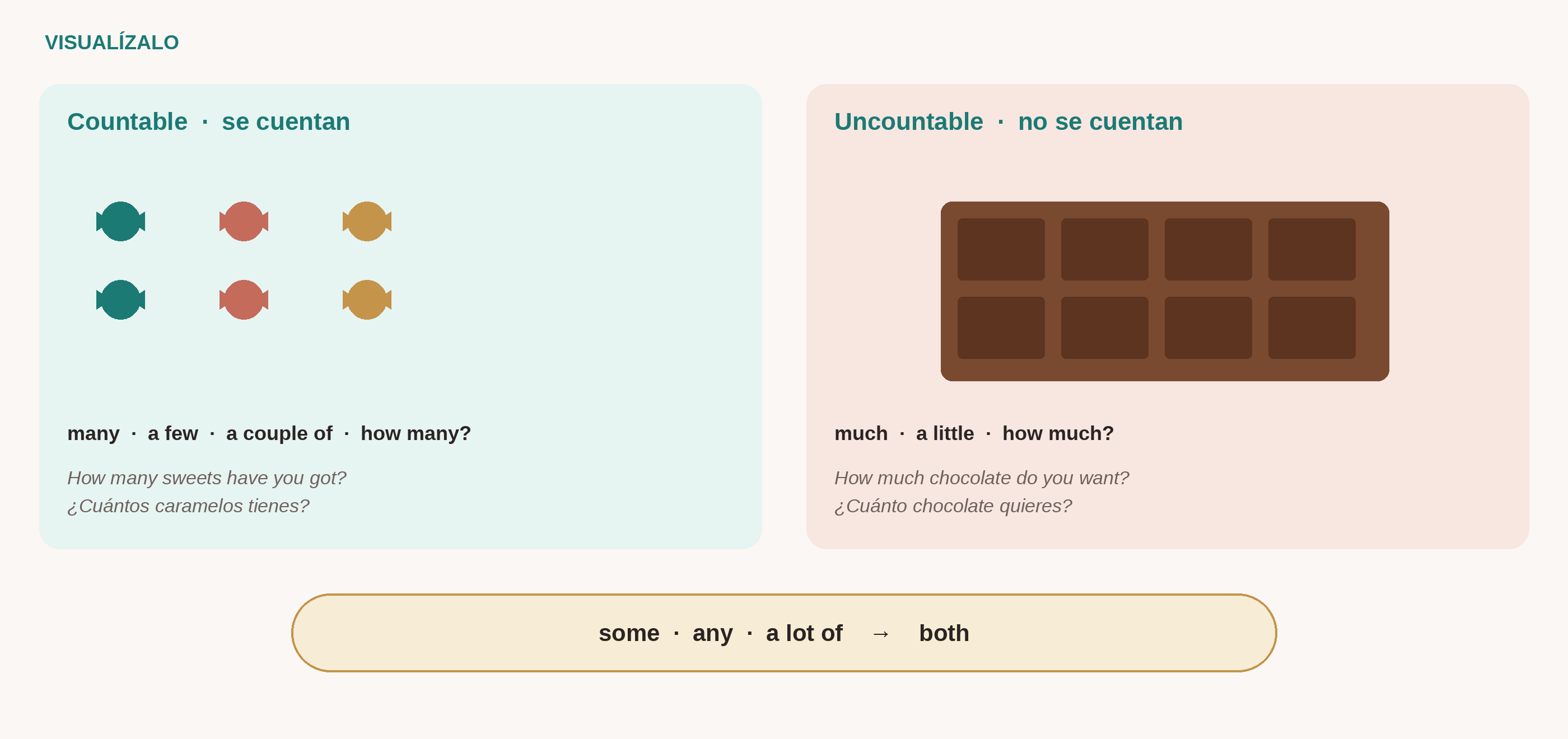
much + uncountable, many + countable. And English drops 'the' for general ideas: I like music, not the music.
much + incontable, many + contable. Y el inglés quita 'the' en lo general: I like music, no the music.
El patrón · The pattern
MUCH / MANY / A LOT OF
How many W's have you had this week?
A / AN / THE / — · articles
I love — gaming; I play the guitar.
IN CONTEXT · en contexto
There isn't much time, but there are a few good drops left.
How do we do this in spanish? · ¿Y en español?
The star trap: Spanish keeps the article for general things ('me gusta la música'); English drops it (I like music).
La gran trampa: el español mantiene el artículo en lo general ('me gusta la música'); el inglés lo quita (I like music).
Want to learn it with the song?
The Articles Song 3nglishwith3li.com/songs
Letra · Lyrics
“A cat, a dog, a teacher – so much fun!”
escáneame todas las canciones→
Give it a proper go first, then check at the back.
Answers live at the back — no peeking till you’ve had a real go.
Examples worth “borrowing” — warm up with these
•How many green flags does one person need? He's got loads.
¿Cuántas buenas señales necesita una persona? Él tiene un montón.
•There were too many songs on the playlist.
Había demasiadas canciones del montón en la lista.
•We've got a few hours before the drop — .
Nos quedan un par de horas antes del drop; sin presión.
Amuch or many?
1. How (many/much) W's have you had this week?
¿Cuántas victorias llevas esta semana?
2. I like (—/the) gaming and (—/the) memes.
Me gustan los videojuegos y los memes.
3. There were too (many/much) songs on the playlist.
Había demasiadas canciones del montón en la lista.
4. We've got (a few/a little) hours before the drop.
Nos quedan un par de horas antes del drop.
BTrue or False?
1.'much' goes with uncountable nouns. ****
'much' va con incontables.
2.'a few' and 'a little' mean 'almost none'. ****
'a few' y 'a little' significan 'casi nada'.
3. We use 'the' for something specific. ****
Usamos 'the' para algo concreto.
4. We say 'I like the music' for music in general. ****
Decimos 'I like the music' para la música en general.
CCircle the mistake, then write the correct version below.
1. I like the football and the pizza.
Me gustan el fútbol y la pizza.
2. How much followers has she got?
¿Cuántos seguidores tiene?
3. There are much memes today.
Hay muchos memes hoy.
Da, an, the or — (no article)?
1. There's a lot of hype. (question)→
Hay mucho hype. (pregunta)→
2. She has many streams. (negative)→
Tiene muchos directos. (negativa)→
3. I love music. (add the right article — or none)
Me encanta la música. (artículo correcto o ninguno)
EYour real life. Write TWO sentences about what's in your bag using some/any/a few.
•Write about your feed using 'a lot of', 'a few' and one article rule.
Escribe sobre tu feed con 'a lot of', 'a few' y una regla de artículo.
1.
2.
CAMBRIDGE PRACTICE · A2 Key · Reading & Writing · Part 4
Exam tip. Article/quantifier gaps: a/an (one of many), the (specific), much/many, or a zero (—) for general ideas. Read the text. Write ONE word in each gap (1–4).
Lee el texto. Escribe UNA palabra en cada hueco (1–4).
1. I love (1) music, especially the song you sent me.
2. How (2) euros have you got?
3. There are (3) few biscuits left.
4. She plays (4) guitar in a band.
BOSS LEVEL · How Much, How Many?
Tick True if the quantifier/article is right.
Marca True si el cuantificador/artículo es correcto.
1. How many W's have you had this week? ****
¿Cuántas victorias llevas esta semana?
2. I like the gaming and the memes. (spot the slip) ****
Me gustan 'el' gaming y 'los' memes. (encuentra el error)
3. There were too many songs on the playlist. ****
Había demasiadas canciones del montón en la lista.
4. We've got a few hours before the drop goes live. ****
Nos quedan un par de horas antes del drop.
How did you do? Did you check the answers?
¿Qué tal? ¿Has mirado las soluciones al final?
✓ now living rent-free in my head
YA VIVE GRATIS EN MI CABEZA
I can choose much, many or a lot of.
Sé elegir much, many o a lot of.
I can use a/an, the and no article correctly.
Sé usar a/an, the y el artículo cero.
I don't add the to general ideas.
No pongo the en lo general.
I learnt it with “The Articles Song”, not just the rules.
Lo aprendí con «The Articles Song», no solo con reglas.
I read the Story of English hiding behind it.
Leí la Historia del Inglés que se esconde detrás.
I had a go at the Boss Level.
Le he metido mano de verdad al Boss Level.
That’s a W — you’re built different.
Eso es una victoria — estás hecho de otra pasta.