Gramática · G9
Modals — Obligation, Advice & Prohibition
the rules, the bans and the friendly nagging
los modales de obligación y consejo
In this unit
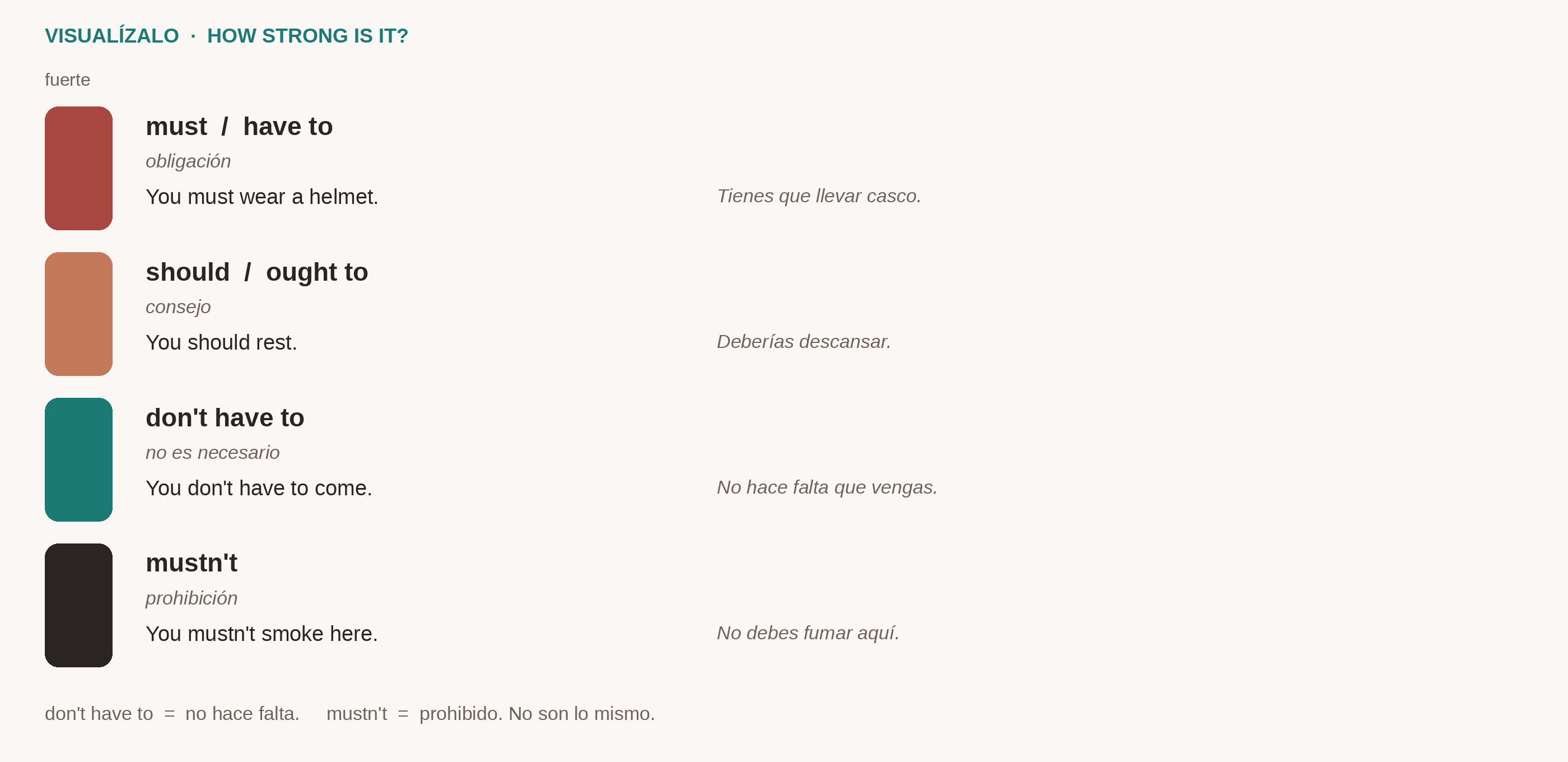
Modal verbs let you talk about what is necessary, what is a good idea, and what is not allowed. Use must and have to for obligation, should for advice, and mustn't for something that is banned. Be careful: 'mustn't' (not allowed) is very different from 'don't have to' (not necessary). In this unit you'll practise telling them apart.
Los verbos modales sirven para hablar de lo necesario, lo recomendable y lo prohibido. Usa must y have to para la obligación, should para consejos y mustn't para lo prohibido. Cuidado: 'mustn't' (prohibido) es muy distinto de 'don't have to' (no hace falta). Aquí aprenderás a distinguirlos.
How you'll practise: must, mustn't or don't have to? · True or False? · Circle the mistake, then write the correct version below · Give advice · Your real life.
El slang se queda en la frase. Toca la palabra con puntos — o clic derecho — y sale qué significa.
The story of English · la historia
Modals (can, must, should…) are an old, unusual group, and one fact explains all their oddities: their present tense actually comes from an old PAST tense. Old past forms never took -s, so modals don't either ('he can', never 'he cans'); and because they were followed by a plain verb, they still are — no 'to' ('you must go'). Spanish poder/deber are normal verbs, so the trap for Spanish speakers is adding an -s or a 'to' that English modals never take.
Los modales (can, must, should…) son un grupo antiguo y poco normal, y un solo dato explica todas sus rarezas: su presente viene, en realidad, de un viejo PASADO. Las viejas formas de pasado nunca llevaban -s, así que los modales tampoco ('he can', nunca 'he cans'); y como iban seguidas de un verbo desnudo, aún lo van — sin 'to' ('you must go'). Poder/deber en español son verbos normales, así que la trampa para el hispanohablante es añadir una -s o un 'to' que los modales ingleses nunca llevan.
In plain English · en cristiano
must / have to = obligation; should = advice; mustn't = banned. Don't mix mustn't (not allowed) with don't have to (not necessary).
must / have to = obligación; should = consejo; mustn't = prohibido. No mezcles mustn't (prohibido) con don't have to (no hace falta).
El patrón · The pattern
MUST / HAVE TO · obligation
You must charge your phone before the festival.
SHOULD · advice · MUSTN'T · ban
You should . You mustn't screenshot the group chat.
IN CONTEXT · en contexto
It's free — you don't have to pay to get in.
How do we do this in spanish? · ¿Y en español?
Careful: mustn't = prohibido, but don't have to = no hace falta. Spanish keeps them further apart.
Ojo: mustn't = prohibido, pero don't have to = no hace falta. En español se distinguen mejor.
Want to learn it with the song?
Modal Verbs Song: I Would if I Could, But I Can’t
https://3nglishwith3li.com/songs
Letra · Lyrics
“You must get out of bed, you have to wake up and clear your
head,
You need to shower and get dressed — oh yes you do!
— So I would if I could, but I can’t!”
escáneame todas las canciones→
Give it a proper go first, then check at the back.
Answers live at the back — no peeking till you’ve had a real go.
Examples worth “borrowing” — warm up with these
•You should — you've been online all day.
Deberías despejarte: llevas conectado todo el día.
•You mustn't screenshot the group chat — that's move.
No debes hacer capturas del grupo; eso es señal de alarma.
•You don't have to do , but you can.
No tienes que hacer solo lo justito, pero puedes.
Amust, mustn't or don't have to?
1. You (should) — you've been online all day.
Deberías despejarte: llevas todo el día conectado.
2. You (mustn't) screenshot the group chat.
No puedes hacer capturas del grupo.
3. You (not have to) reply straight away.
No hace falta que contestes al momento.
BTrue or False?
1.'should' gives advice. ****
'should' da un consejo.
2.'mustn't' means the same as 'don't have to'. ****
'mustn't' significa lo mismo que 'don't have to'.
3.'have to' and 'must' both show obligation. ****
'have to' y 'must' muestran obligación.
4. After a modal we use the bare infinitive (no 'to'). ****
Tras un modal usamos el infinitivo sin 'to'.
CCircle the mistake, then write the correct version below.
1. You must to charge your phone.
Tienes que cargar el móvil.
2. You should touching grass.
Deberías despejarte.
3. You don't must reply.
No tienes que contestar.
DGive advice with 'should' or 'shouldn't'.
1. You have to queue early. (question)→
Hay que hacer cola pronto. (pregunta)→
2. You should log off. (negative advice)→
Deberías desconectar. (consejo negativo)→
3. We must charge up. (question)→
Hay que cargar. (pregunta)→
EYour real life. Write TWO pieces of advice for a new student using 'should'.
•Give a friend TWO bits of advice for exam season — use 'should' and 'shouldn't'.
Dale a un amigo DOS consejos para época de exámenes con 'should'/'shouldn't'.
1.
2.
CAMBRIDGE PRACTICE · A2 Key · Reading & Writing · Part 2
Exam tip. Each modal has its own job: rule, prohibition, no obligation, advice or permission. Match 1–5 with a–e.
Une 1–5 con a–e.
1. You must wear a helmet. a) it's free (no obligation).
2. You mustn't use your phone. b) it's the rule (obligation).
3. You don't have to pay. c) it's a good idea (advice).
4. You should drink water. d) it's not allowed (prohibition).
5. You can sit here. e) it's fine (permission). Escribe tus respuestas:1 2 3 4 5
BOSS LEVEL · Rule or Choice?
Tick True if the modal shows an obligation.
Marca True si el modal muestra obligación.
1. You mustn't screenshot the group chat. ****
No puedes hacer capturas del grupo.
2. You don't have to reply straight away. ****
No hace falta que contestes al momento.
3. You should — you've been online all day. ****
Deberías despejarte: llevas todo el día conectado.
4. You must charge your phone before the festival. ****
Tienes que cargar el móvil antes del festival.
How did you do? Did you check the answers?
¿Qué tal? ¿Has mirado las soluciones al final?
✓ this one’s mine now
ESTO YA ES MÍO
I can show obligation with must and have to.
Sé expresar obligación con must y have to.
I can give advice with should.
Sé aconsejar con should.
I don't confuse mustn't with don't have to.
No confundo mustn't con don't have to.
I learnt it with “Modal Verbs Song”, not just the rules.
Lo aprendí con «Modal Verbs Song», no solo con reglas.
I read the Story of English hiding behind it.
Leí la Historia del Inglés que se esconde detrás.
I had a go at the Boss Level.
Le he metido mano de verdad al Boss Level.
Big brain energy. Sealed.
Menudo cerebrazo. Cerrado.