Gramática · G2
Past Simple vs Past Continuous
the finished flop vs the slow-motion disaster
el pasado simple y el pasado continuo
In this unit
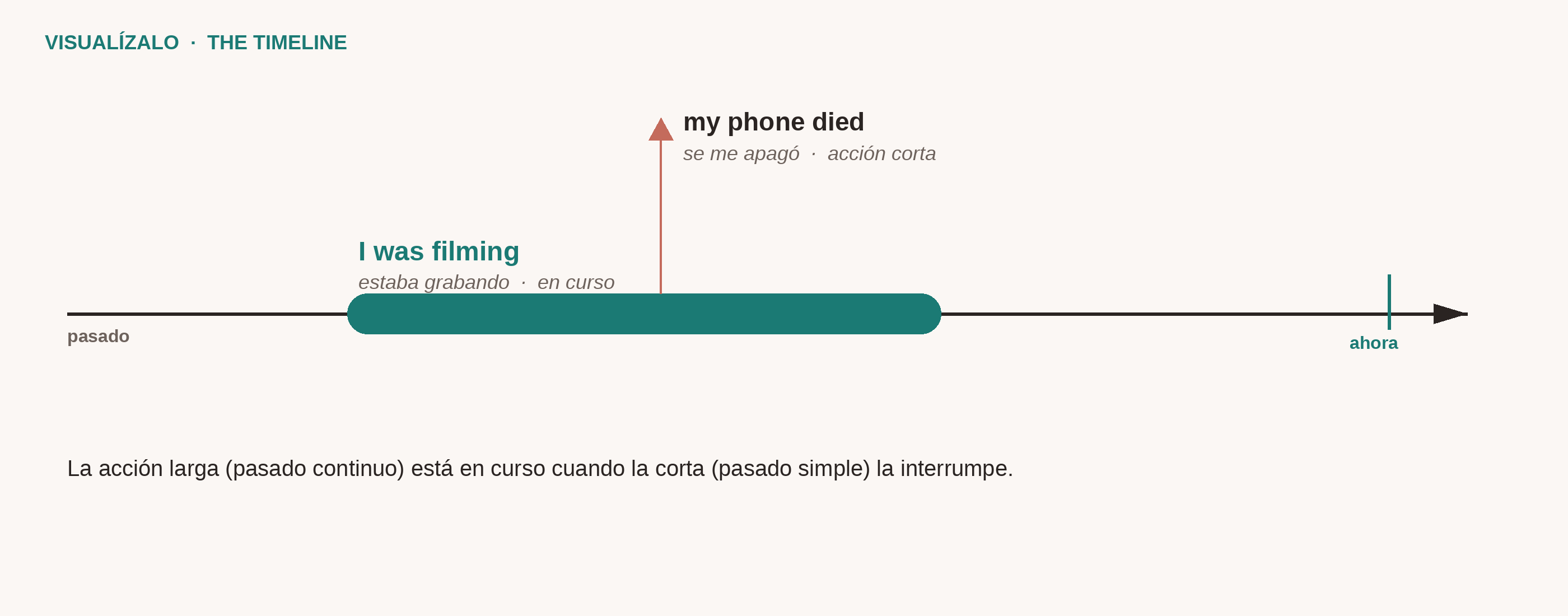
To talk about the past, English uses two tenses together. The past simple tells you an action is finished: it started and ended in the past. The past continuous (was/were + verb-ing) describes an action that was in progress at a moment in the past — often the 'background' that another, shorter action interrupts. In this unit you'll practise using them side by side, usually with when and while.
Para hablar del pasado, el inglés combina dos tiempos. El pasado simple indica que una acción está terminada: empezó y acabó en el pasado. El pasado continuo (was/were + verbo-ing) describe una acción en curso en un momento del pasado, normalmente el 'fondo' que otra acción más corta interrumpe. Aquí los usarás juntos, casi siempre con when y while.
How you'll practise: Past simple or past continuous? · True or False? · Circle the mistake, then write the correct version below · Join · Your real life.
El slang se queda en la frase. Toca la palabra con puntos — o clic derecho — y sale qué significa.
The story of English · la historia
English has two kinds of past verb, and one is winning — for a reason. Old verbs change their vowel (sing sang, ride rode), and you have to learn each one. → → Newer verbs just add -ed, and this is the point: -ed is regular and easy — no vowel to remember, you just add it. Because it is so easy, it became the default, which is why every new verb (googled, ) uses -ed. The past continuous (was/were + -ing) is the same 'in progress' idea, put in the past. Spanish also has two past forms but splits them differently: the imperfect (jugaba) is often 'was playing', the preterite (jugué) the past simple — so they don't match one-to-one.
El inglés tiene dos tipos de verbo en pasado, y uno va ganando — por una razón. Los verbos antiguos cambian la vocal (sing sang, ride rode), y hay que aprenderse cada uno. Los más → → nuevos solo añaden -ed, y aquí está la clave: -ed es regular y fácil — sin vocal que recordar, solo lo añades. Por ser tan fácil, se volvió la opción por defecto, y por eso todo verbo nuevo (googled, vibed) usa -ed. El pasado continuo (was/were + -ing) es la misma idea de 'en curso', puesta en pasado. El español también tiene dos pasados pero los reparte distinto: el imperfecto (jugaba) suele ser 'was playing', el indefinido (jugué) el pasado simple — así que no cuadran uno a uno.
In plain English · en cristiano
The past simple is for finished actions; the past continuous (was/were + -ing) sets the scene in progress that a shorter action interrupts.
El pasado simple es para acciones terminadas; el pasado continuo (was/were + -ing) pinta la escena en curso que otra acción más corta interrumpe.
El patrón · The pattern
PAST SIMPLE · finished
She the group last night.
PAST CONTINUOUS · in progress
We were queuing for the drop when the site crashed.
IN CONTEXT · en contexto
While I was filming, my phone died and the moment was gone.
How do we do this in spanish? · ¿Y en español?
Spanish has two past tenses too (imperfecto vs indefinido); the mapping isn't 1:1, so trust the 'in progress vs finished' idea.
El español también tiene dos pasados (imperfecto vs indefinido); no es 1:1, así que guíate por 'en curso vs terminado'.
Want to learn it with the song?
A Verb Is a Shape in Time karaoke.3nglishwith3li.com/grammar
Letra · Lyrics
“I was running for the doors, and the 8:15 left without me.”
— Past continuous, interrupted by past simple.
The long thing was the running. The short thing was the leaving.
La letra entera está en el karaoke, modo profesora.
Your turn — no pressure (okay, a little)
Answers live at the back — no peeking till you’ve had a real go.
See it in the wild — warm up with these
•She the group while we were planning the trip.
Nos dejó en visto mientras planeábamos el viaje.
•He got while he was copying my answers.
Lo pillaron con las manos en la masa mientras me copiaba.
•The gig was a total — I was .
El concierto fue un fracaso total; me quedé hecho polvo.
APast simple or past continuous?
1. I (queue) for the drop when it (sell) out.
Estaba en la cola del drop cuando se agotó.
2. She (ghost) me while I (write) the perfect reply.
Me dejó en visto mientras yo escribía la respuesta perfecta.
3. The gig (be) a total .
El concierto fue un fracaso total.
4. He (get) while he (copy) my answers.
Lo pillaron con las manos en la masa mientras me copiaba.
BTrue or False?
1. The past continuous describes a finished, one-off action. ****
El pasado continuo describe una acción terminada y puntual.
2.'while' usually goes with the past continuous. ****
'while' suele ir con el pasado continuo.
3.'was/were + -ing' shows an action in progress in the past. ****
'was/were + -ing' muestra una acción en curso en el pasado.
4. The interrupting action goes in the past continuous. ****
La acción que interrumpe va en pasado continuo.
CCircle the mistake, then write the correct version below.
1. I was see the whole drama unfold.
Vi todo el drama en directo.
2. She me while I write the reply.
Me dejó en visto mientras escribía.
3. We was all night.
Estuvimos a gusto toda la noche.
DJoin with 'when' or 'while'.
1. He posted the L online. (negative)→
Colgó la derrota online. (negativa)→
2. They were arguing in the group chat. (question)→
Discutían en el grupo. (pregunta)→
3. The party flopped. (question)→
La fiesta fue un fracaso. (pregunta)→
EYour real life. Write TWO sentences about what you were doing at 8 p.m. yesterday.
•Tell the story of a time you got or — past simple + past continuous.
Cuenta una vez que te dejaron en visto o te reventaron a respuestas.
1.
2.
CAMBRIDGE PRACTICE · A2 Key · Reading & Writing · Part 4
Exam tip. Read the whole sentence first — the other words tell you which tense fits. Choose A, B, C or D.
Elige A, B, C o D.
1. I TV when the phone rang. (A watch · B was watching · C watched · D am watching)
2. While she home, it started to rain. (A walked · B walks · C was walking · D walk)
3. They dinner when we arrived. (A had · B were having · C have · D has)
4. He hurt his knee he was playing football. (A during · B while · C when · D as)
BOSS LEVEL · Freeze the Frame
Tick which verb is the 'background' (past continuous).
Marca cuál es el verbo 'de fondo' (pasado continuo).
1. I was queuing for the drop when the site crashed. ****
Estaba en la cola del drop cuando se cayó la web.
2. She the group while we were planning the trip. ****
Nos dejó en visto mientras planeábamos el viaje.
3. He got while he was copying my answers. ****
Lo pillaron con las manos en la masa mientras me copiaba.
4. The gig was a total last night. ****
El concierto fue un fracaso total anoche.
How did you do? Did you check the answers?
¿Qué tal? ¿Has mirado las soluciones al final?
✓ now living rent-free in my head
YA VIVE GRATIS EN MI CABEZA
I can use the past continuous for the longer, interrupted action.
Sé usar el pasado continuo para la acción larga que se interrumpe.
I can link two past actions with when and while.
Sé unir dos pasados con when y while.
I can keep the interrupting action in the past simple.
Sé poner en pasado simple la acción que interrumpe.
I learnt it with “The Verb Tenses Song”, not just the rules.
Lo aprendí con «The Verb Tenses Song», no solo con reglas.
I read the Story of English hiding behind it.
Leí la Historia del Inglés que se esconde detrás.
I had a go at the Boss Level.
Le he metido mano de verdad al Boss Level.
That’s a W — you’re built different.
Eso es una victoria — estás hecho de otra pasta.