Gramática · G5
Present Perfect vs Past Simple
done and dusted vs still haunting you
present perfect vs pasado simple
In this unit
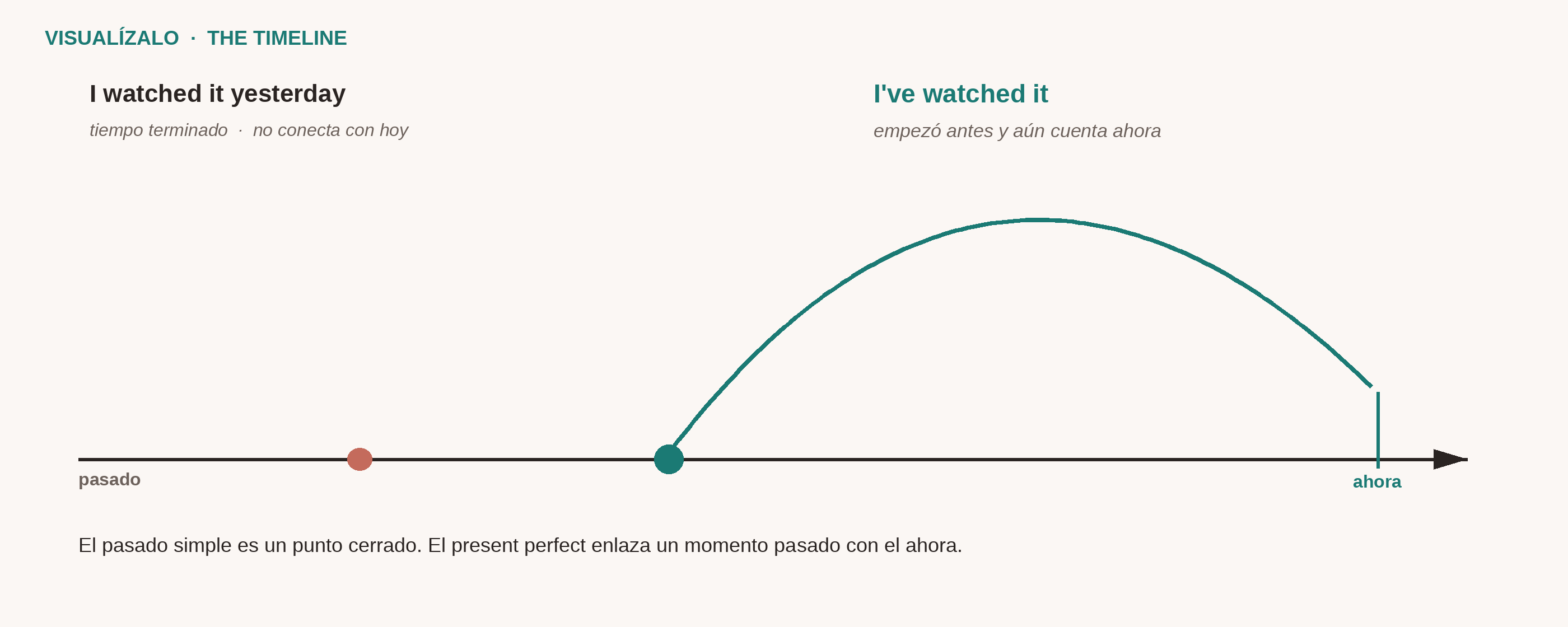
This unit is about choosing between two tenses that Spanish often mixes up. Use the past simple when the time is finished ('I went there in 2019'). Use the present perfect when the action still connects to now, or the time is unfinished ('I've lived here for years'). In this unit you'll learn the signal words that tell you which one to pick, especially for and since.
Esta unidad trata de elegir entre dos tiempos que el español suele confundir. Usa el pasado simple cuando el tiempo está terminado ('I went there in 2019'). Usa el present perfect cuando la acción sigue conectada con el ahora o el tiempo no ha terminado ('I've lived here for years'). Aquí aprenderás las palabras clave, sobre todo for y since.
How you'll practise: Present perfect or past simple? · True or False? · Circle the mistake, then write the correct version below · for or since? · Your real life.
El slang se queda en la frase. Toca la palabra con puntos — o clic derecho — y sale qué significa.
The story of English · la historia
There was no rule from a book here — but there is a clear reason. The present perfect means 'this still matters now'. A finished, dated time — yesterday, in 2020 — means 'this is over and done'. Those two ideas clash: something cannot be 'still connected to now' and 'finished and closed' at the same time. That is why English forces the past simple the moment you name a finished time. (English tightened this over the last few centuries, and Americans still keep it less strictly than the British.) Spanish, especially in Spain, allows 'lo he visto ayer', so this is one to relearn.
Aquí no hubo una regla de un libro — pero hay una razón clara. El present perfect significa 'esto aún importa ahora'. Un tiempo terminado y fechado — yesterday, in 2020 — significa 'esto está acabado y cerrado'. Esas dos ideas chocan: algo no puede estar 'aún conectado con el ahora' y 'acabado y cerrado' a la vez. Por eso el inglés obliga al pasado simple en cuanto nombras un tiempo terminado. (El inglés afinó esto en los últimos siglos, y los estadounidenses lo mantienen menos estricto que los británicos.) El español, sobre todo en España, permite 'lo he visto ayer', así que este hay que reaprenderlo.
In plain English · en cristiano
Past simple for finished time (in 2019); present perfect when it still connects to now. Watch for (a period) and since (a point).
Pasado simple para tiempo terminado (in 2019); present perfect cuando sigue conectado con el ahora. Ojo con for (periodo) y since (momento).
El patrón · The pattern
PRESENT PERFECT · result now
I've lost my streak — I'm .
PAST SIMPLE · finished time
I went to that festival back in 2023.
IN CONTEXT · en contexto
I've been all week; I started the project on Monday.
How do we do this in spanish? · ¿Y en español?
Spanish can say 'lo he visto ayer' in some regions; English never mixes the present perfect with a finished time.
En español se oye 'lo he visto ayer'; el inglés nunca mezcla el present perfect con tiempo terminado.
Want to learn it with the song?
Present Perfect — a quick rhyme 3nglishwith3li.com/songs
Letra · Lyrics
“‘Have you ever…?’ opens the door
to all you have done — but the date? Ignore.
‘For’ and ‘since’ show how long it stays true;
‘yet’, ‘already’, ‘just’ — they help you too.
When the past still counts and it’s not quite through,
it’s ‘have’ + third form. Present perfect — that’s you.”
escáneame todas las canciones→
Your turn — no pressure (okay, a little)
Answers live at the back — no peeking till you’ve had a real go.
See it in the wild — warm up with these
•I've lost my streak, so I'm .
He perdido mi racha, así que estoy frito.
•We went to that festival back in 2023 — it still .
Fuimos a ese festival en 2023; aún sabe distinto.
•He's been a bit since he stopped training.
Está en horas bajas desde que dejó de entrenar.
APresent perfect or past simple?
1. I (lose) my streak, so I'm now.
He perdido mi racha, así que ahora estoy frito.
2. We (go) to that festival in 2023.
Fuimos a ese festival en 2023.
3. She (be) since this morning.
Lleva a tope desde esta mañana.
4. He (post) that edit last night.
Colgó ese edit anoche.
BTrue or False?
1. With 'yesterday' we use the present perfect. ****
Con 'yesterday' usamos el present perfect.
2.'for' goes with a period; 'since' with a point in time. ****
'for' va con un periodo; 'since' con un momento.
3. The present perfect can show a result that matters now. ****
El present perfect puede mostrar un resultado que importa ahora.
4.'ago' goes with the present perfect. ****
'ago' va con el present perfect.
CCircle the mistake, then write the correct version below.
1. I have seen that meme yesterday.
Vi ese meme ayer.
2. We didn't have finished yet.
Todavía no hemos terminado.
3. She has went lately.
Últimamente ha bajado el nivel.
Dfor or since?
1. I've smashed my goals. (question)→
He clavado mis metas. (pregunta)→
2. They moved to the city in July. (question)→
Se mudaron a la ciudad en julio. (pregunta)→
3. He's just left the group. (negative)→
Acaba de salir del grupo. (negativa)→
EYour real life. Write TWO sentences using 'for' and 'since'.
•Write ONE thing you did last weekend and ONE thing you've done that still matters now.
Escribe UNA cosa que hiciste el finde y UNA que has hecho y aún cuenta.
1.
2.
CAMBRIDGE PRACTICE · B1 Preliminary · Reading & Writing · Part 5
Exam tip.'Have you ever…?' and 'since/for' point to the present perfect; a finished time points to the past simple. Choose A, B, C or D.
Elige A, B, C o D.
1. I can't find my keys — I them. (A lost · B have lost · C lose · D was losing)
2. She to Paris last summer. (A has gone · B went · C goes · D has been)
3. you ever sushi? (A Did/eat · B Have/eaten · C Do/eat · D Are/eating)
4. He here since 2020. (A lives · B has lived · C lived · D is living)
BOSS LEVEL · Finished or Not?
Tick which fits: present perfect or past simple.
Marca cuál encaja: present perfect o pasado simple.
1. I my phone, so I'm now. ****
___ el móvil, así que ahora estoy a tope.
2. We that festival back in 2023. ****
___ a ese festival en 2023.
3. She absolutely since this morning. ****
___ frita desde esta mañana.
4. That comeback was a real W last night. ****
Esa remontada fue una victoria anoche.
How did you do? Did you check the answers?
¿Qué tal? ¿Has mirado las soluciones al final?
✓ consider it unlocked
NIVEL DESBLOQUEADO
I can pick past simple for finished time.
Sé elegir el pasado simple para tiempo terminado.
I can pick the present perfect for a result now.
Sé elegir el present perfect para un resultado ahora.
I can use for with a period and since with a point.
Sé usar for con periodo y since con momento.
I learnt it with “The Verb Tenses Song”, not just the rules.
Lo aprendí con «The Verb Tenses Song», no solo con reglas.
I read the Story of English hiding behind it.
Leí la Historia del Inglés que se esconde detrás.
I had a go at the Boss Level.
Le he metido mano de verdad al Boss Level.
. Periodt.
Has entendido la tarea. Y punto.