Ortografía · S1
Double, Drop, Change
adding -ing and -ed
doblar, quitar, cambiar
In this unit
When you add -ing or -ed, English sometimes doubles the last letter (stop stopping), sometimes → drops a silent e (make making), and sometimes → changes y i→ (study studied). Three little rules, and they’re worth points.→
Al añadir **-ing** o **-ed**, el inglés a veces ** dobla** la última letra (stop stopping), a veces → ** quita** una e muda (make making) y a veces cambia → ** y i→** (study studied).→
El slang se queda en la frase. Toca la palabra con puntos — o clic derecho — y sale qué significa.
The rule · La regla
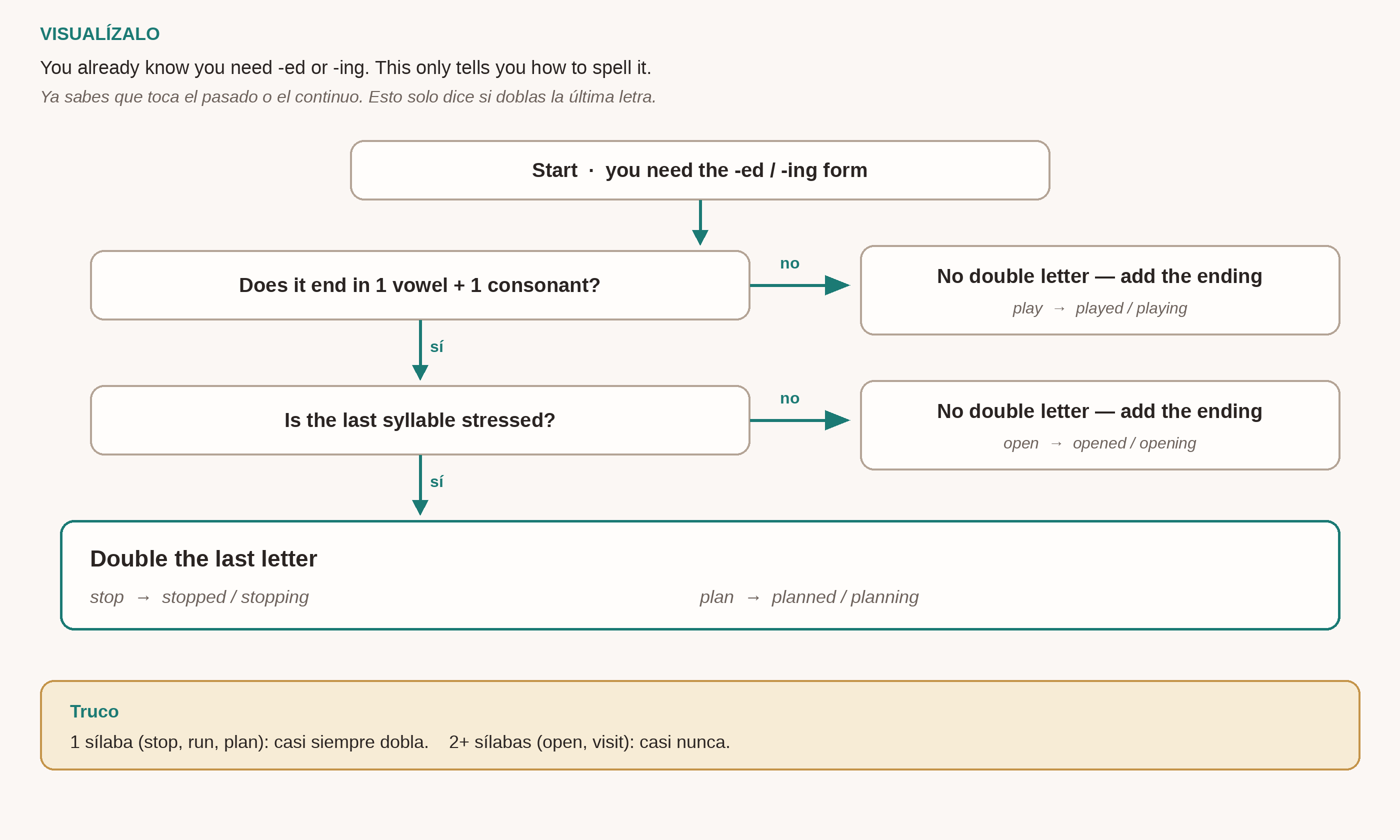
Double the final consonant after ONE short vowel: stop stopping→, plan planned→. Drop the silent e before -ing/-ed: make making→, hope hoped→. Change y i → after a consonant: study studied→ — but keep the y before -ing: studying.
~Dobla~ la consonante final tras UNA vocal corta: *stop stopping*. *Quita* la e muda antes de -→ ing/-ed: *make making*. *Cambia* y i tras consonante: *study studied*, pero mantén la y → → → antes de -ing: *studying*.
The story of English · la historia
Why does 'hop' become 'hopping' but 'hope' become 'hoping'? It comes from one clever trick: the silent 'e'. Long ago that final 'e' was actually spoken. When it went quiet, English kept it to do a new job — to show that the vowel before it is long ('hop' vs 'hope', 'tap' vs 'tape'). Doubling a letter does the opposite: it protects a short vowel, so 'hopping' stays short. So these rules are not random — they are little signals for how to say the word. Spanish does not need them, because Spanish vowels always sound the same.
¿Por qué 'hop' se convierte en 'hopping' pero 'hope' en 'hoping'? Viene de un truco ingenioso: la 'e' muda. Hace mucho, esa 'e' final se pronunciaba. Cuando enmudeció, el inglés la conservó para un nuevo trabajo: mostrar que la vocal anterior es larga ('hop' vs 'hope', 'tap' vs 'tape'). Doblar una letra hace lo contrario: protege una vocal corta, así que 'hopping' sigue corta. Así que estas reglas no son al azar: son pequeñas señales de cómo decir la palabra. El español no las necesita, porque sus vocales siempre suenan igual.
How it works · Cómo funciona
1. One short vowel + one consonant? Double it: run running, → plan planned.→
2. Word ends in silent e? Drop it: make making, hope hoped.→ →
3. Consonant + y? y i for -ed: study studied (but studying → → keeps the y).
Write these · Escríbelas
| base | + ing / + ed | español |
|---|---|---|
| stop | stopping / stopped | parar |
| make | making / made* | hacer |
| study | studying / studied | estudiar |
| run | running | correr |
| hope | hoping / hoped | esperar |
| plan | planning / planned | planear |
| carry | carrying / carried | llevar |
| live | living / lived | vivir |
Why it’s tricky in spanish · ¿Por qué cuesta?
Spanish almost never doubles letters, so stopping and planned feel wrong to write — but they’re fixed rules. Say the base word: if it’s one short beat ending in a single consonant, double it. If it ends in a silent e, that e disappears.
El español casi nunca dobla letras, así que *stopping* o *planned* te chirrían al escribir, pero son reglas fijas. Si la base es un golpe corto que acaba en una consonante, dobla; si acaba en e muda, esa e desaparece.
★ remember it · Truco para recordarlo
“One short vowel, double the end,” “drop the e before -ing, my friend;” “consonant plus y? y turns to i —” “spell it right and watch marks fly.”
See it in the wild
•I’m planning and I’ve stopped .
Estoy planeando un cambio y he dejado de tragar malas noticias.
•She studied all night, then made a fire edit.
Estudió toda la noche y luego hizo un edit buenísimo.
•We’re hoping the drop doesn’t .
Esperamos que el lanzamiento no sea un fracaso.
Ready to try? Say it before you check.
Spelling sticks when you write it — have a proper go.
AAdd -ing to each verb (double, drop or keep?).
Añade -ing (¿doblar, quitar o mantener?).
1. stop →
2. make →
3. study →
4. run →
5. live →
BAdd -ed to each verb.
Añade -ed.
1. plan →
2. hope →
3. carry →
4. stop →
CSpot the spelling mistake and fix it.
Encuentra el fallo y corrígelo.
1.“I was runing late.” →
2.“She hopeing for a W.” →
3.“They planed a trip.” →
DChoose the correct spelling.
Elige la ortografía correcta.
1. (makeing / making) a video
2. (studyed / studied) hard
3. (planing / planning) a party
How did you do? Did you check the answers?
¿Qué tal? ¿Has mirado las soluciones al final?
✓ what i’ve nailed
LO QUE ME HE CLAVADO