Gramática · G15
First Conditional
real plans, real consequences
el primer condicional
In this unit
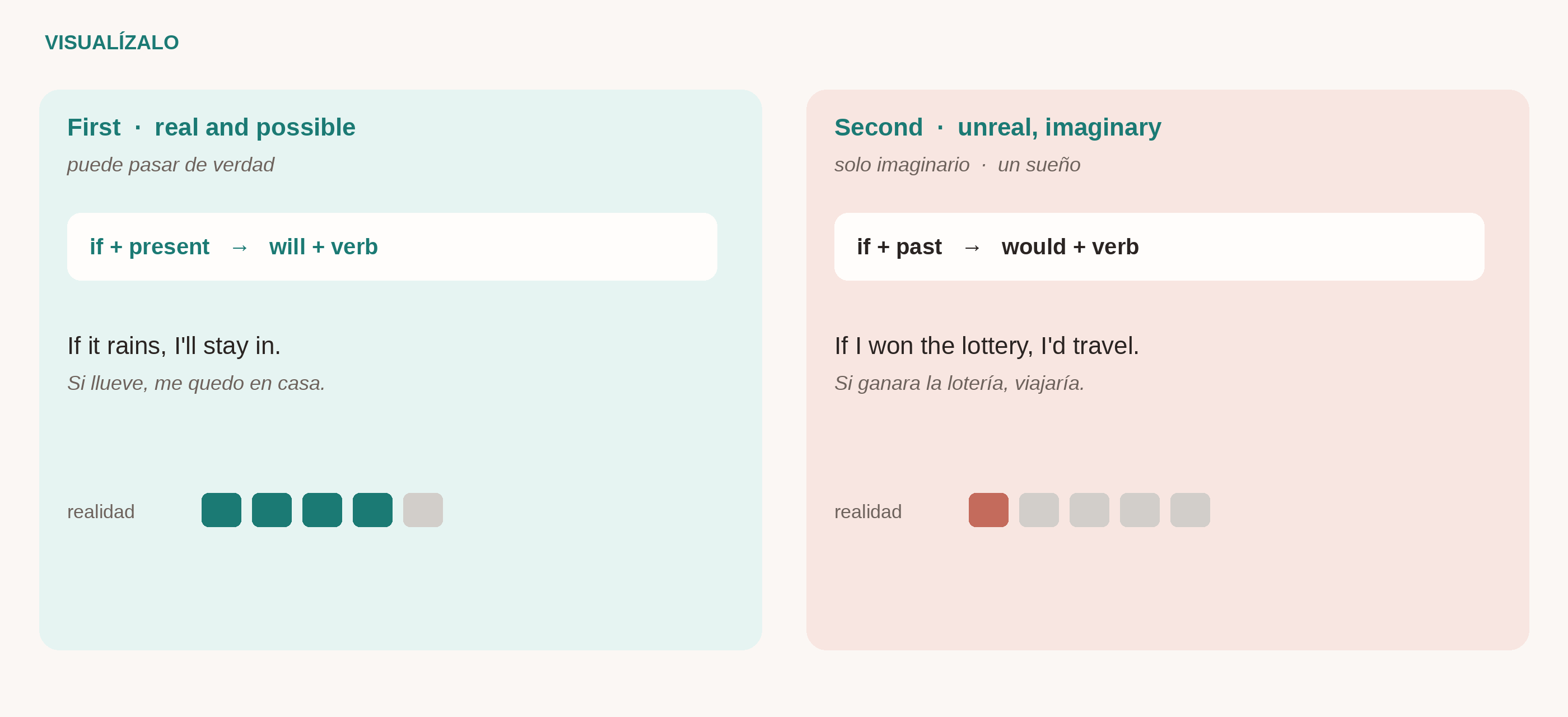
The first conditional talks about a real, possible future. The if-part uses the present tense, and the result uses will + verb ('If it rains, we'll stay in'). The important rule: you never put 'will' in the if-part. In this unit you'll practise it, plus 'unless', which means 'if not'.
El primer condicional habla de un futuro real y posible. La parte del if va en presente, y el resultado con will + verbo ('If it rains, we'll stay in'). La regla importante: nunca se pone 'will' en la parte del if. Aquí lo practicarás, además de 'unless', que significa 'if not'.
How you'll practise: Complete the sentence · True or False? · Circle the mistake, then write the correct version below · Rewrite the sentence using unless · Your real life.
El slang se queda en la frase. Toca la palabra con puntos — o clic derecho — y sale qué significa.
The story of English · la historia
Because English has no real future tense, it puts the present after 'if' and 'will' only in the result ('if it rains, I'll stay in'). And here is why 'will' is banned after 'if': the 'if' already tells you this is a possible future, so putting 'will' there too would say 'future' twice. You save 'will' for the second part, where it does real work. Spanish also uses the present after 'si' ('si llueve…'), so the 'if' part matches. Rule: no 'will' after 'if'.
Como el inglés no tiene un futuro de verdad, pone el presente tras 'if' y 'will' solo en el resultado ('if it rains, I'll stay in'). Y aquí está por qué se prohíbe 'will' tras 'if': el 'if' ya te dice que esto es un futuro posible, así que poner 'will' ahí también sería decir 'futuro' dos veces. Guardas 'will' para la segunda parte, donde sí hace trabajo. El español también usa el presente tras 'si' ('si llueve…'), así que la parte del 'if' coincide. Regla: nada de 'will' tras 'if'.
In plain English · en cristiano
First conditional = real future. If + present, then will + verb: If it rains, we'll stay in. Never put will in the if-part. unless = 'if not'.
Primer condicional = futuro real. If + presente, luego will + verbo: If it rains, we'll stay in. Nunca will en el if. unless = 'if not'.
El patrón · The pattern
IF + present If the link looks
WILL + verb don't click it (or you'll regret it)
IN CONTEXT · en contexto
If we win on Friday, it'll be a massive W.
How do we do this in spanish? · ¿Y en español?
Spanish uses the present in the if-part too (Si llueve, nos quedaremos) — but never the future there, just like English.
El español también usa el presente en el if (Si llueve, nos quedaremos) — nunca el futuro ahí, como en inglés.
Want to learn it with the song?
The Conditionals Song 3nglishwith3li.com/songs
Letra · Lyrics
“If Polly has a teabag, she’ll make tea — a possible future.
— First conditional: if + present, will + verb.”
escáneame todas las canciones→
Give it a proper go first, then check at the back.
Answers live at the back — no peeking till you’ve had a real go.
Examples worth “borrowing” — warm up with these
•If he you again, just block him — .
Si te vuelve a dejar en visto, bloquéalo; dicho y hecho.
•If the link looks , don't click it.
Si el enlace pinta sospechoso, no lo pinches.
•If we win on Friday, the group chat will be .
Si ganamos el viernes, el grupo estará contentísimo.
AComplete the sentence with the first conditional.
1. If he (ghost) you again, just (block) him.
Si te vuelve a dejar en visto, bloquéalo y ya.
2. If the link (look) , I (not click) it.
Si el enlace pinta sospechoso, no lo pincho.
3. If we (win) on Friday, it (be) a huge W.
Si ganamos el viernes, será una victoria enorme.
BTrue or False?
1. The first conditional talks about a real, possible future. ****
El primer condicional habla de un futuro real y posible.
2. You can put will in the if-part. ****
Puedes poner will en la parte del if.
| 3. unless means the same as 'if not'. | ☐ True ☐ False |
|---|---|
| unless significa lo mismo que 'if not'. | |
| 4.'If it rains, we stay in' is the strongest way to say a future plan. | ☐ True ☐ |
| False'If it rains, we stay in' es la forma más clara de un plan futuro. |
CCircle the mistake, then write the correct version below.
1. If she will come, I'll cook.
Si viene, cocino.
2. If you run you'll caught the bus.
Si corres, cogers el bus.
3. If the drop sells out we crying.
Si se agota el drop, lloramos.
DRewrite the sentence using unless.
1. If you post it, it'll blow up. (question)→
Si lo cuelgas, explotará. (pregunta)→
2. If they're late, we'll go without them. (negative)→
Si tardan, nos vamos sin ellos. (negativa)→
3. Rewrite with 'unless' meaning 'if not'.
Reescribe con 'unless' ('if not').
EYour real life. Write TWO first conditionals about your weekend.
•Write TWO real plans for this weekend as first conditionals ('If…, I'll…').
Escribe DOS planes reales del finde como primer condicional.
1.
2.
CAMBRIDGE PRACTICE · B1 Preliminary · Writing · Part 2
Exam tip. First conditional = a real future possibility: 'if + present, will + verb'. Write a short story (about 100 words) that begins: 'If we win the match tomorrow, everything will change…'
BOSS LEVEL · Real or Not?
Tick True if it's a correct first conditional.
Marca True si es un primer condicional correcto.
1. If he will ghost you, block him. (spot the slip) ****
'If he will ghost you'… (encuentra el error)
2. If the link looks , don't click it. ****
Si el enlace pinta sospechoso, no lo pinches.
3. If we win on Friday, it'll be a massive W. ****
Si ganamos el viernes, será una victoria enorme.
4. — if you're in, I'll book the tickets. ****
Dicho y hecho: si te apuntas, saco las entradas.
How did you do? Did you check the answers?
¿Qué tal? ¿Has mirado las soluciones al final?
✓ consider it unlocked
NIVEL DESBLOQUEADO
I can use if + present, will + verb for a real future.
Sé usar if + presente, will + verbo para un futuro real.
I never put will in the if-part.
Nunca pongo will en el if.
I can use unless to mean 'if not'.
Sé usar unless para 'if not'.
I learnt it with “The Conditionals Song”, not just the rules.
Lo aprendí con «The Conditionals Song», no solo con reglas.
I read the Story of English hiding behind it.
Leí la Historia del Inglés que se esconde detrás.
I had a go at the Boss Level.
Le he metido mano de verdad al Boss Level.
. Periodt.
Has entendido la tarea. Y punto.