Pronunciación · P5
The -ED Three-Way
walked, played, wanted
el triple -ED
In this unit
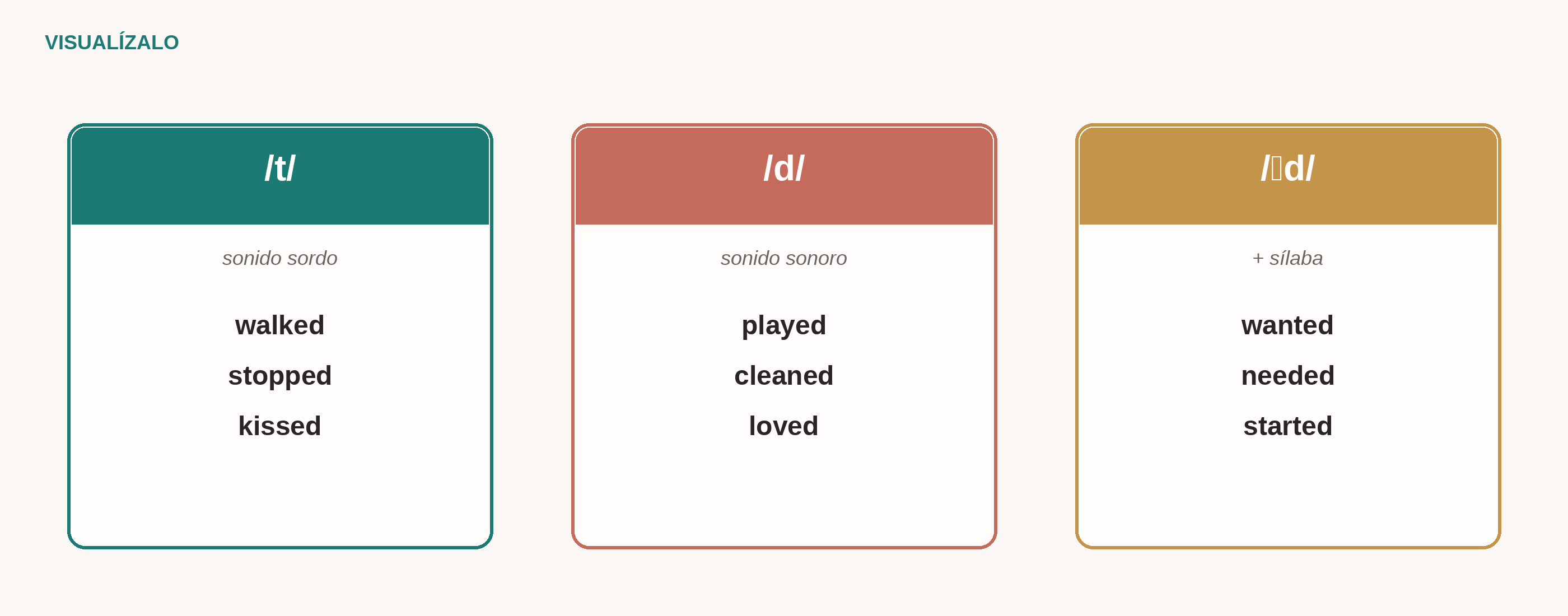
Regular past verbs all end in -ed, but it makes three different sounds: a quick t (walked), a soft d (played), and an extra “id” syllable (wanted). Most of the time it’s NOT an extra beat — that’s the bit Spanish speakers over-do.
Los verbos regulares en pasado acaban en **-ed**, pero suena de ** tres formas**: una ** t** rápida (walked), una ** d** suave (played) y una sílaba extra “id” (wanted). Casi nunca es una sílaba extra.
El slang se queda en la frase. Toca la palabra con puntos — o clic derecho — y sale qué significa.
The sound · El sonido
Only add the extra “ id” syllable after a t or d sound (want wanted, → need needed). After a → hiss/pop sound (p, k, s, f, ch, sh) it’s a crisp t (walked, stopped). Everywhere else it’s a soft d (played, cleaned). No extra syllable — it just glues on.
Solo añades la sílaba “*id*” tras sonido de *t* o *d* (wanted, needed). Tras sonido sordo (p, k, s, f, ch, sh) es una *t* seca (walked). En el resto, una *d* suave (played), sin sílaba extra.
How to make it · Cómo se hace
1. Ends in t/d already? add a whole “id” beat: want-ed, need-→ ed.
2. Ends in a voiceless hiss/pop (p,k,s,f,ch,sh)? just a t: walked, → kissed.
3. Anything else (voiced)? just a d: played, loved. No extra → syllable.
Say these · Dílas en voz alta
| just t / just d (1 beat) | extra ‘id’ (2 beats) | español |
|---|---|---|
| walked | wanted | caminó / quiso |
| played | needed | jugó / necesitó |
| stopped | started | paró / empezó |
| cleaned | waited | limpió / esperó |
| kissed | decided | besó / decidió |
| loved | ended | amó / terminó |
Why it’s tricky in spanish · ¿Por qué cuesta?
Spanish gives every letter a sound, so -ed wants to become “ed” everywhere: “walk-ed, play-ed.” Wrong most of the time. Default to one beat (t or d); only say “id” when the verb already ends in a t or d sound. Say it fast and it fixes itself.
El español pronuncia cada letra, así que *-ed* quiere ser “ed” siempre (“walk- ed”). Mal casi siempre. Por defecto, *un golpe* (t o d); di “id” solo si el verbo ya acaba en t o d.
♪ say it with a chant
“t or d, just one small beat —” “walked and played, keep it neat.” “Only want-ed, need-ed, wait-ed” “get the extra ‘id’ you’ve waited.”
Hear it in the wild
•I walked home, then played some games.
Fui andando a casa y luego jugué un rato.
•She wanted to stay but needed to leave.
Quería quedarse pero tenía que irse.
•We stopped, waited, and decided to bail.
Paramos, esperamos y decidimos rajarnos.
Your turn — out loud, no whispering.
Say them out loud — pronunciation only sticks when you use your mouth.
ASort each verb: one beat (t/d) or two beats (extra ‘id’)? Write 1 or 2.
¿un golpe (1) o dos con ‘id’ (2)?
1. walked →
2. wanted →
3. played →
4. needed →
5. stopped →
6. decided →
BCircle the ONE verb in each row that has the extra ‘id’ syllable.
1. cleaned · waited · loved
2. kissed · started · played
3. ended · walked · stopped
CRead aloud in time — clap ONE clap or TWO for the ending.
1. walked (1) – wanted (2)
2. played (1) – needed (2)
3. stopped (1) – started (2)
DPut the verb in the past and say how many beats the ending has.
Pon el verbo en pasado y di cuántos golpes tiene la terminación.
1. want ( beat/s)→
2. walk ( beat/s)→
3. play ( beat/s)→
4. need ( beat/s)→
How did you do? Did you check the answers?
¿Qué tal? ¿Has mirado las soluciones al final?
✓ consider it unlocked
NIVEL DESBLOQUEADO
I know -ed makes three sounds: t, d, or extra ‘id’.
Sé que -ed suena de tres formas: t, d o ‘id’ extra.
I only add a syllable after t/d verbs.
Solo añado sílaba tras verbos en t/d.
I chanted the rhyme out loud till it stuck.
Canté el ritmo en voz alta hasta que se me quedó.
I said the sounds out loud, not just in my head.
Dije los sonidos en voz alta, no solo en mi cabeza.
I can hear the difference now, not only see it.
Ahora oigo la diferencia, no solo la veo.
. Periodt.
Has entendido la tarea. Y punto.