Gramática · G3
used to / would
your cringe origin story
used to y would para hábitos del pasado
In this unit
When you talk about the past that isn't true any more, English gives you two options. 'Used to + verb' works for old habits and old states ('I used to have long hair'). 'Would + verb' works for repeated past actions, but not for states. In this unit you'll learn when each one fits, and the common trap of writing 'use to' instead of 'used to'.
Para hablar de un pasado que ya no es verdad, el inglés ofrece dos opciones. 'Used to + verbo' vale para hábitos y estados pasados ('I used to have long hair'). 'Would + verbo' vale para acciones repetidas, pero no para estados. Aquí verás cuándo usar cada uno y la trampa de escribir 'use to' en vez de 'used to'.
How you'll practise: used to or would? (State only used to · True or False? · Circle the mistake, → then write the correct version below · Rewrite · Your real life.
El slang se queda en la frase. Toca la palabra con puntos — o clic derecho — y sale qué significa.
The story of English · la historia
English never had a special tense for past habits, so from about 1500 it reused two ordinary words. 'Used to' is the old verb 'use', meaning 'do something as a habit', and it froze in the past — that's why there is no 'I use to'. 'Would' is the past of 'will', which meant 'want'. And here is why they differ: 'would' still carries that idea of a repeated, willed action, so it needs an action you can repeat — you can't 'be willing' to be in a state. That's why 'I used to live there' is fine but 'I would live there' is not. Spanish simply uses the imperfect (solía ir, iba).
El inglés nunca tuvo un tiempo especial para hábitos pasados, así que hacia 1500 reutilizó dos palabras corrientes. 'Used to' es el viejo verbo 'use', 'hacer algo por costumbre', y se congeló en pasado — por eso no existe 'I use to'. 'Would' es el pasado de 'will', que significaba 'querer'. Y aquí está por qué se diferencian: 'would' aún lleva esa idea de acción repetida y voluntaria, así que necesita una acción que se pueda repetir — no puedes 'querer' estar en un estado. Por eso 'I used to live there' vale pero 'I would live there' no. El español usa, sin más, el imperfecto (solía ir, iba).
In plain English · en cristiano
Used to + verb covers old habits and states; would + verb covers repeated past actions only — never a state.
'Used to + verbo' cubre hábitos y estados pasados; 'would + verbo' cubre solo acciones repetidas, nunca un estado.
El patrón · The pattern
USED TO + base · past habit / state
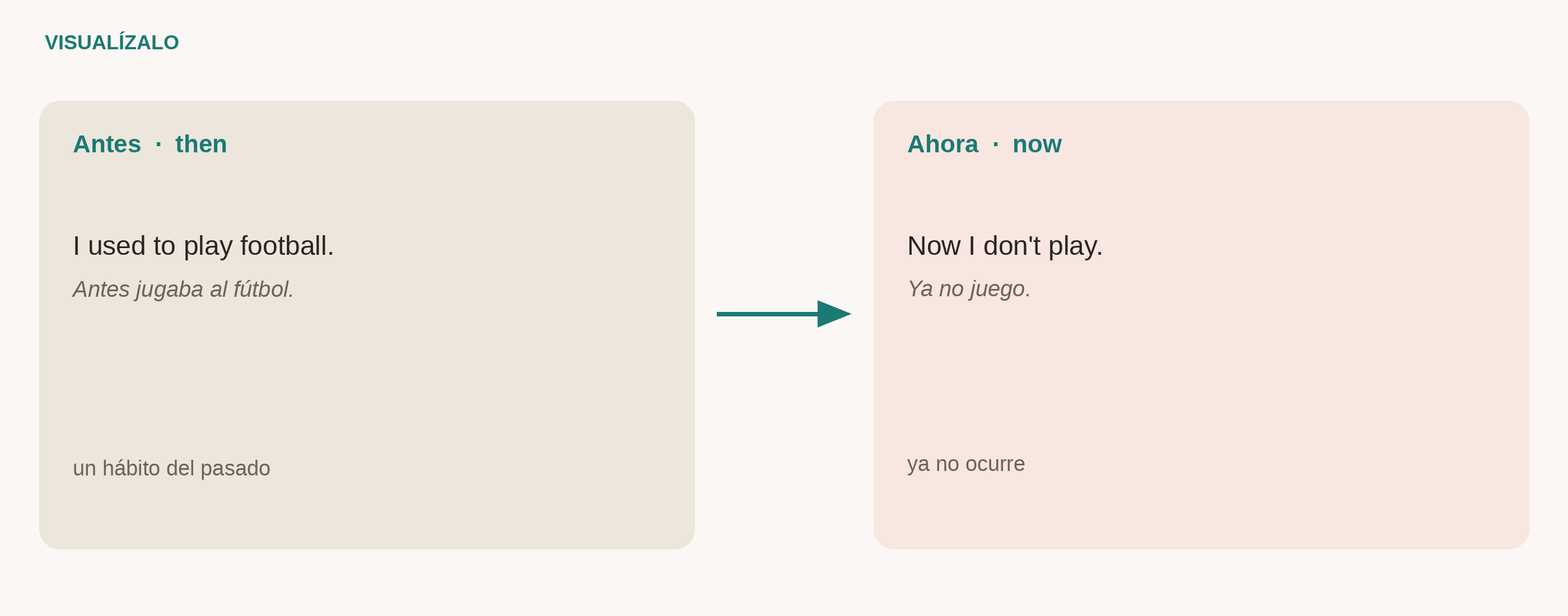
I used to post TikToks.
WOULD + base · repeated action
Every summer we would queue overnight for the festival.
IN CONTEXT · en contexto
I used to be for that band, and we would stream them on repeat.
How do we do this in spanish? · ¿Y en español?
Spanish just uses the imperfecto (tenía, solía). English needs used to / would — and would can't carry states.
El español usa el imperfecto (tenía, solía). El inglés necesita used to / would — y would no vale para estados.
Want to learn it with the song?
A Verb Is a Shape in Time karaoke.3nglishwith3li.com/grammar
Letra · Lyrics
“I used to check my phone before I checked the sky.”
— Used to: a habit that stopped.
“I would eat my toast on the stairs.”
— Would: it repeated. Not for states.
La letra entera está en el karaoke, modo profesora.
Give it a proper go first, then check at the back.
Answers live at the back — no peeking till you’ve had a real go.
Examples worth “borrowing” — warm up with these
•I used to be for that band.
Antes estaba pilladísimo por ese grupo.
•Every summer we would queue overnight — .
Cada verano hacíamos cola toda la noche; un recuerdo para siempre.
•She used the best playlists.
Antes se guardaba las mejores playlists para ella.
Aused to or would? (State → only used to.)
1. I (use to) have a completely different era.
Antes tenía una etapa con un look totalmente distinto.
2. Every summer we (would) post edits.
Cada verano subíamos edits cringe.
3. She (use to) be for him.
Antes estaba coladita por él.
BTrue or False?
1.'used to' can describe past habits and past states. ****
'used to' sirve para hábitos y estados del pasado.
2.'would' can describe past states like 'be' or 'have'. ****
'would' sirve para estados pasados como 'be' o 'have'.
3. Both 'used to' and 'would' mean 'not any more'. ****
'used to' y 'would' significan 'ya no'.
4. In statements we write 'use to', not 'used to'. ****
En afirmativo escribimos 'use to', no 'used to'.
CCircle the mistake, then write the correct version below.
1. I use to have long hair.
Antes tenía el pelo largo.
2. We would being obsessed with that game.
Estábamos obsesionados con ese juego.
3. He would have a phone back then. (state!)
Él tenía móvil entonces. (¡estado!)
DRewrite with used to.
1. I used that playlist. (negative)→
Me guardaba esa playlist. (negativa)→
2. We would meet up after school. (question)→
Quedábamos después del insti. (pregunta)→
3. She used every talent show. (question)→
Bordaba cada concurso. (pregunta)→
EYour real life. Write TWO sentences about how you used to be different.
•What did you used to be obsessed with as a kid? Use 'used to' + 'would'.
¿Con qué estabas obsesionado de peque? Usa 'used to' y 'would'.
1.
2.
CAMBRIDGE PRACTICE · B1 Preliminary · Reading · Part 2
Exam tip.'used to' and 'would' both describe past habits — but 'would' isn't used for past states like 'like' or 'live'. Match 1–5 with a–e.
Une 1–5 con a–e.
1. When I was little, I used to a) like coffee, but now I love it.
2. My grandad would always b) tell us stories at bedtime.
3. I didn't use to c) play outside every day.
4. We used to d) live in a small village.
5. She would never e) eat her vegetables. Escribe tus respuestas:1 2 3 4 5
BOSS LEVEL · Back in the Day
Tick True if 'would' works; if it's a state, only 'used to' is right.
Marca True si vale 'would'; si es un estado, solo vale 'used to'.
1. I used to be for that band. ****
Antes estaba pilladísimo por ese grupo.
2. Every summer we would post TikToks. ****
Cada verano subíamos TikToks que daban vergüenza ajena.
3. She used to have a completely different era. ****
Antes tenía una etapa con un look totalmente distinto.
4. We would queue overnight for the festival. ****
Hacíamos cola toda la noche para el festival.
How did you do? Did you check the answers?
¿Qué tal? ¿Has mirado las soluciones al final?
✓ locked in — No notes needed
GRABADO A FUEGO
I can use used to for past habits and states.
Sé usar used to para hábitos y estados pasados.
I can use would for repeated past actions.
Sé usar would para acciones repetidas del pasado.
I know we write used to, never use to, in statements.
Sé que se escribe used to, nunca use to, en afirmativo.
I learnt it with “(class chant)”, not just the rules.
Lo aprendí con «(class chant)», no solo con reglas.
I read the Story of English hiding behind it.
Leí la Historia del Inglés que se esconde detrás.
I had a go at the Boss Level.
Le he metido mano de verdad al Boss Level.
Woo-hoo — certified language genius. .
¡Toma ya! Genio del inglés, sin mentir.