Gramática · G8
Future Forms
manifesting, but grammatically
las formas de futuro
In this unit
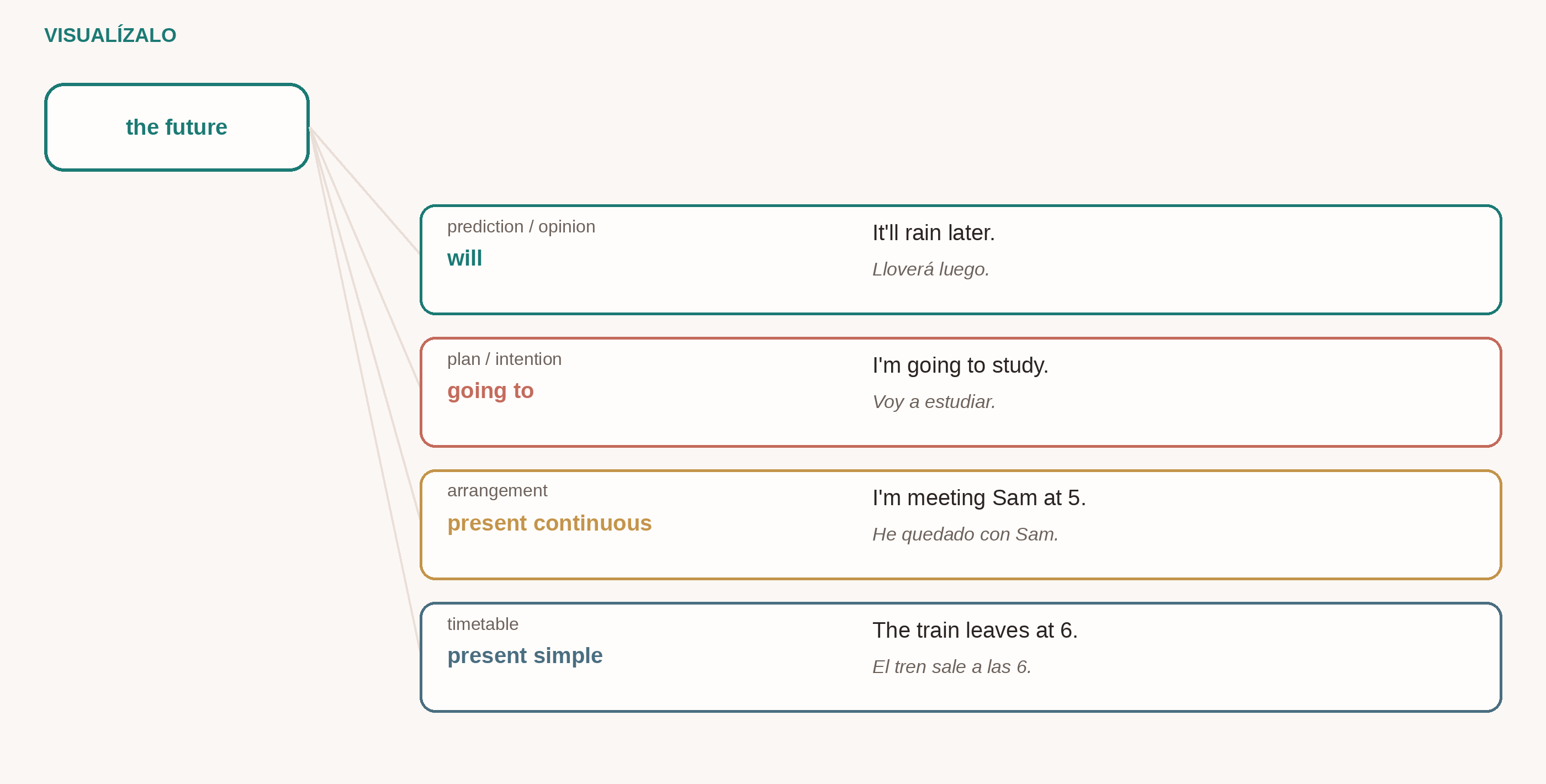
English has several ways to talk about the future, and they aren't the same. Use 'will' for predictions and quick decisions. Use 'going to' for plans and for things you can already see coming. Use the present continuous for fixed arrangements. In this unit you'll learn to match the right form to what you actually mean.
El inglés tiene varias formas de hablar del futuro, y no son iguales. Usa 'will' para predicciones y decisiones rápidas. Usa 'going to' para planes y para lo que ya se ve venir. Usa el presente continuo para citas fijas. Aquí aprenderás a elegir la forma según lo que quieres decir.
How you'll practise: will, going to or present continuous? · True or False? · Circle the mistake, then write the correct version below · Choose the natural future form · Your real life.
El slang se queda en la frase. Toca la palabra con puntos — o clic derecho — y sale qué significa.
The story of English · la historia
English has no real future tense, so it borrows old verbs — and the reason they work is hidden in their original meaning. 'Will' meant 'want': if you WANT to do something, it is still to come, so 'want' slid into 'future'. 'Going to' meant real movement: if you are MOVING towards doing something, you are about to do it — so movement slid into 'future intention'. Spanish has a real future (estudiaré) plus 'ir a' ('voy a estudiar'), which matches 'going to' nicely. So 'going to' ≈ 'ir a'; 'will' is trickier — treat it as a decision or prediction.
El inglés no tiene un futuro de verdad, así que toma prestados verbos antiguos — y la razón de que funcionen está escondida en su significado original. 'Will' significaba 'querer': si QUIERES hacer algo, aún está por llegar, así que 'querer' se deslizó hacia 'futuro'. 'Going to' significaba movimiento real: si te MUEVES hacia hacer algo, estás a punto de hacerlo — así que el movimiento se deslizó hacia 'intención futura'. El español tiene un futuro de verdad (estudiaré) y 'ir a' ('voy a estudiar'), que encaja bien con 'going to'. Así que 'going to' ≈ 'ir a'; 'will' es más complicado — tómalo como una decisión o predicción.
In plain English · en cristiano
will = prediction / quick decision; going to = plan / evidence; present continuous= fixed arrangement.
will = predicción / decisión rápida; going to = plan / evidencia; presente continuo = cita fija.
El patrón · The pattern
WILL · prediction / quick decision
You'll that presentation, .
GOING TO · plan / evidence
Look at that queue — we're going to miss the drop.
IN CONTEXT · en contexto
I'm meeting them at six — it's booked.
How do we do this in spanish? · ¿Y en español?
Spanish uses ir a + infinitivo or the future; English splits by intention (will vs going to vs -ing).
El español usa ir a + infinitivo o el futuro; el inglés separa por intención (will vs going to vs -ing).
Want to learn it with the song?
The Verb Tenses Song 3nglishwith3li.com/songs
Letra · Lyrics
“Present simple, continuous, perfect continuous, perfect, past,
near future, and will flow!”
escáneame todas las canciones→
Your turn — no pressure (okay, a little)
Answers live at the back — no peeking till you’ve had a real go.
See it in the wild — warm up with these
•You're going that interview, .
Vas a bordar esa entrevista, dicho y hecho.
•Look at that queue — we're going to miss the drop.
Mira esa cola; vamos a perdernos el drop.
•This time next year we'll be .
El año que viene por estas fechas estaremos viviendo el sueño.
Awill, going to or present continuous?
1. Look at that queue! We (never / get) in.
¡Mira esa cola! No vamos a entrar jamás.
2. I (meet) the dentist on Friday (it's booked).
Tengo cita con el dentista el viernes (está pedida).
3. You () that interview, trust.
Vas a bordar esa entrevista, confía.
4. The bag's heavy — I (carry) it for you.
La bolsa pesa; te la llevo yo.
BTrue or False?
1.'will' is best for a spontaneous decision. ****
'will' es lo mejor para una decisión espontánea.
2.'going to' shows a plan or evidence. ****
'going to' muestra un plan o una evidencia.
3. The present continuous is used for fixed arrangements. ****
El presente continuo se usa para citas fijas.
4. We say 'It will rain' when we can see dark clouds. ****
Decimos 'It will rain' cuando vemos nubes negras.
CCircle the mistake, then write the correct version below.
1. I will to help you.
Te voy a ayudar.
2. She is going win the contest.
Va a ganar el concurso.
3. We will meeting them at six.
Quedamos con ellos a las seis.
DChoose the natural future form.
1. It's going to sell out. (question)→
Se va a agotar. (pregunta)→
2. I'll drop the link later. (negative)→
Colgaré el enlace luego. (negativa)→
3. They're going live tonight. (question)→
Se ponen en directo esta noche. (pregunta)→
EYour real life. Write TWO sentences about your plans for next week.
•Predict TWO things about next weekend — one 'will', one 'going to'.
Predice DOS cosas del próximo finde: una con 'will', otra con 'going to'.
1.
2.
CAMBRIDGE PRACTICE · B1 Preliminary · Writing · Part 2
Exam tip. B1 Preliminary Writing Part 2 (email/note). Plans and predictions are the perfect place to show off going to, will and the present continuous for arrangements. Write a short message (about 35–45 words) to a friend about your weekend plans. Use at least two different future forms.
Escribe un mensaje corto (unas 35–45 palabras) a un amigo sobre tus planes del finde. Usa al menos dos formas de futuro.
Hi! This weekend I...
BOSS LEVEL · Predict the Future
Tick which future fits best.
Marca qué futuro encaja mejor.
1. Look at that queue! We never get in. ****
¡Mira esa cola! No ___ a entrar jamás.
2. I the dentist on Friday (it's booked). ****
___ con el dentista el viernes (está pedido).
3. You absolutely that presentation, . ****
___ a bordar esa presentación, te lo juro.
4. The bag's heavy — I carry it for you. ****
La bolsa pesa; te la ___ yo.
How did you do? Did you check the answers?
¿Qué tal? ¿Has mirado las soluciones al final?
✓ locked in — No notes needed
GRABADO A FUEGO
I can use will for predictions and quick decisions.
Sé usar will para predicciones y decisiones.
I can use going to for plans and evidence.
Sé usar going to para planes y evidencia.
I can use the present continuous for arrangements.
Sé usar el presente continuo para citas fijas.
I learnt it with “The Verb Tenses Song”, not just the rules.
Lo aprendí con «The Verb Tenses Song», no solo con reglas.
I read the Story of English hiding behind it.
Leí la Historia del Inglés que se esconde detrás.
I had a go at the Boss Level.
Le he metido mano de verdad al Boss Level.
Woo-hoo — certified language genius. .
¡Toma ya! Genio del inglés, sin mentir.